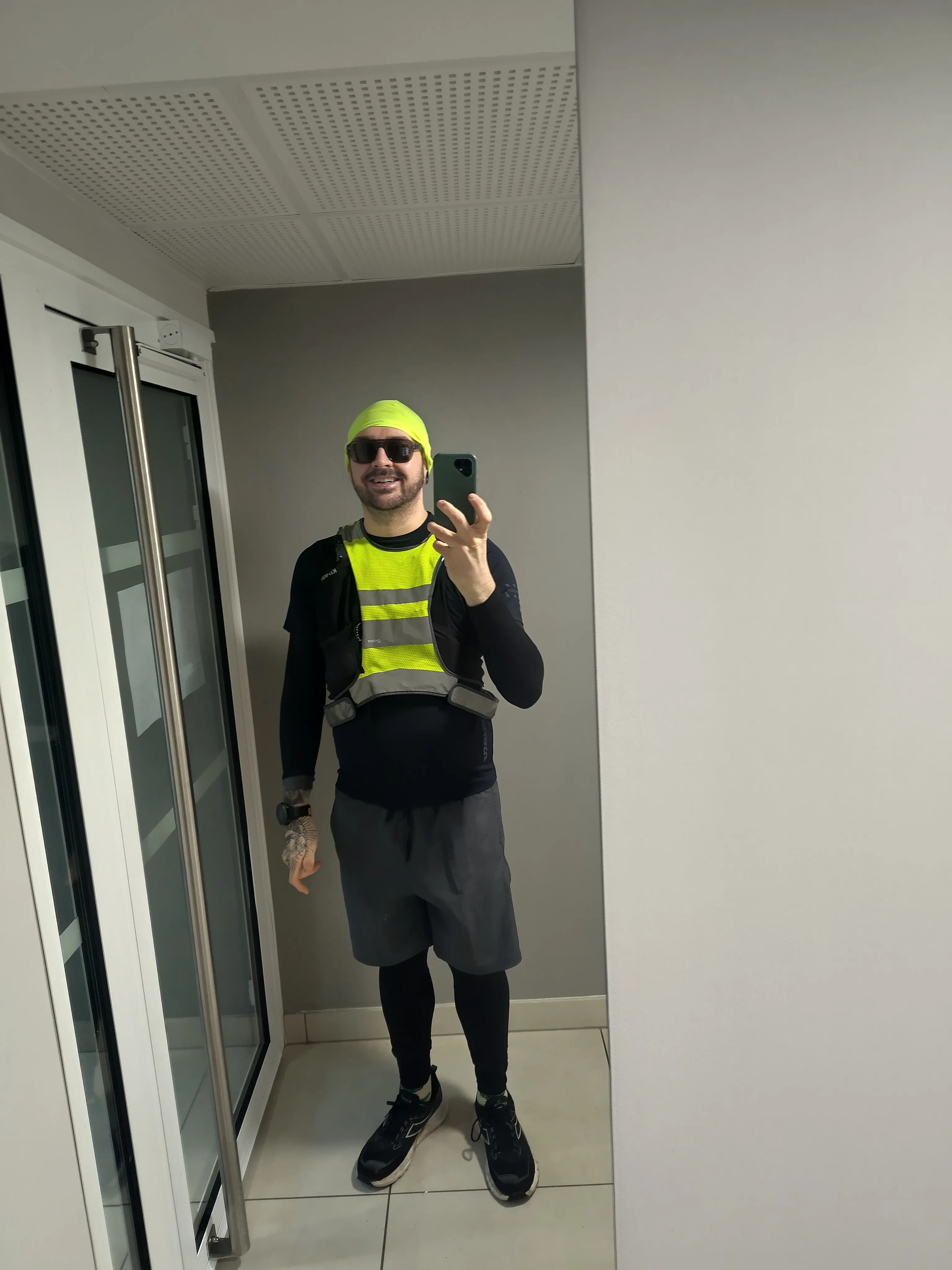
The story often starts with a challenge among friends.
I’ve been working out for years at Le Punch gym (fitness, cross-training, taekwondo, kickboxing…). Last year, my workout buddies (Léa, Mathias, Franck, Phillippe, Antoine) completed the 2025 Nancy half-marathon with excellent times, some even breaking the mythical two-hour mark. That was all it took for me to say: “Why not me?”.
I started running alone in May 2025. Very quickly, faced with the complexity of endurance training, I reached out to Mortimer DUBOIS (aka Morty) to coach me. The goal was clear: the Nancy half-marathon on March 29, 2026.
Here is the analysis of this year of preparation, from the data of my “engine” to the final mechanical bug.
1. The Engine: Building a Diesel Heart
As a data geek, I tracked every heartbeat of this prep, equipped with my Garmin watch and my Polar H10 chest strap (essential for reliable high-intensity data).
The results of a year of structured training are physiologically fascinating:
- VO2Max: I went from an estimated 40 to 44 ml/kg/min. A solid 10% increase in my aerobic “engine” in one year.
- Heart Rate Spectrum: I discovered I had a resting heart rate of 46 BPM (the famous athletic bradycardia) and a maximum heart rate measured on the track at 196 BPM. A 150-beat range that gives me tremendous leeway.
Extracting my Garmin data (over 166 hours of running analyzed), the distribution of my effort is undeniable: 96.7% of my volume was done in Fundamental Endurance (Zones 1 and 2, under 152 BPM). I built a massive aerobic base without unnecessarily exhausting myself on every run.
2. The Strategy: Millimeter-Perfect Pacing and Nutrition
Thanks to my recent 10k personal best (La Ronde Hivernale in 58:03, or 5:48/km), we calibrated a race pace of 6:10/km for the half. At this pace, my heart rate settles comfortably at 145 BPM. I was exactly where I needed to be: at the upper limit of Zone 2, able to burn fat without accumulating lactic acid.
For energy, I developed a “metronome” strategy based on Näak nutrition:
- Solid Energy: One 25g carb gel every 4.2 km.
- Hydration: 10 regular intakes (every 1.4 km) of diluted isotonic drink to spare the stomach, along with a 500ml flask of clear water to help absorb the gels.
On paper, I was programmed to finish around 2h10 in optimal comfort.
3. The System Bug: The Training Load Error
Then, the mechanics gave out.
In early March, I did a big 21 km test run. My cardio was perfectly fine, but my tendons started to complain. I felt a slight initial discomfort. This is where I made the classic amateur runner’s mistake: I looked at my training plan instead of listening to my body. I continued to accumulate load, adding a heavy 17 km session with pace blocks, only to completely blow up mid-flight on Wednesday, March 18, during a 30-minute threshold session.
!
[Image of Posterior Tibial Tendinopathy] (../../../assets/post-tib.webp)
The next morning: impossible to put my foot on the ground. Emergency consultation (physio and sports doctor in under 24h). The diagnosis fell: Posterior Tibial Tendinopathy. A tendon inflamed by repeated impact and accumulated fatigue.
Verdict: no half-marathon in 2026.
4. Reboot: Objective 2027
Investing a year only to miss the starting line 10 days before the event is frustrating. But data also teaches us to put things into perspective. The physiological work is not lost. The heart and lungs don’t just evaporate.
I decided to make the best of this situation. My doctor cleared me to maintain activity as long as the pain stays under 4/10 (the famous Silbernagel protocol). So, I’m switching to “cross-training” mode:
- Cycling: To keep my VO2Max intact without any impact on my tendons.
- Strength Training: I’m continuing my classes at Le Punch and my rehab with the physio to forge titanium legs.
The initial goal was to finish the half in 2026. The goal has simply been updated: Nancy 2027, and this time, we’re going for the “Sub-2h”.
The data is saved. The system is rebooting. See you next year!